


Portfolio Construction Architecture
An Overview For SOVEREIGN
Introduction
The architecture is typically one of the most significant differentiators between market approaches and infrastructure capabilities. Our core architecture is informed by manual trading principles for risk and sizing, translated into systematic execution.
While some systems utilize continuous signals (cross-sectional, hedging, and others), most of our systems employ a binary signal approach.
Signal Types: Binary vs. Continuous
Continuous Signal: Constant size and risk adjustment as signal strength changes. The position scales dynamically with conviction.
Binary Signal: "Set and forget" positioning where size and risk are fixed at trade entry. Once established, the position remains unchanged until exit conditions are met.
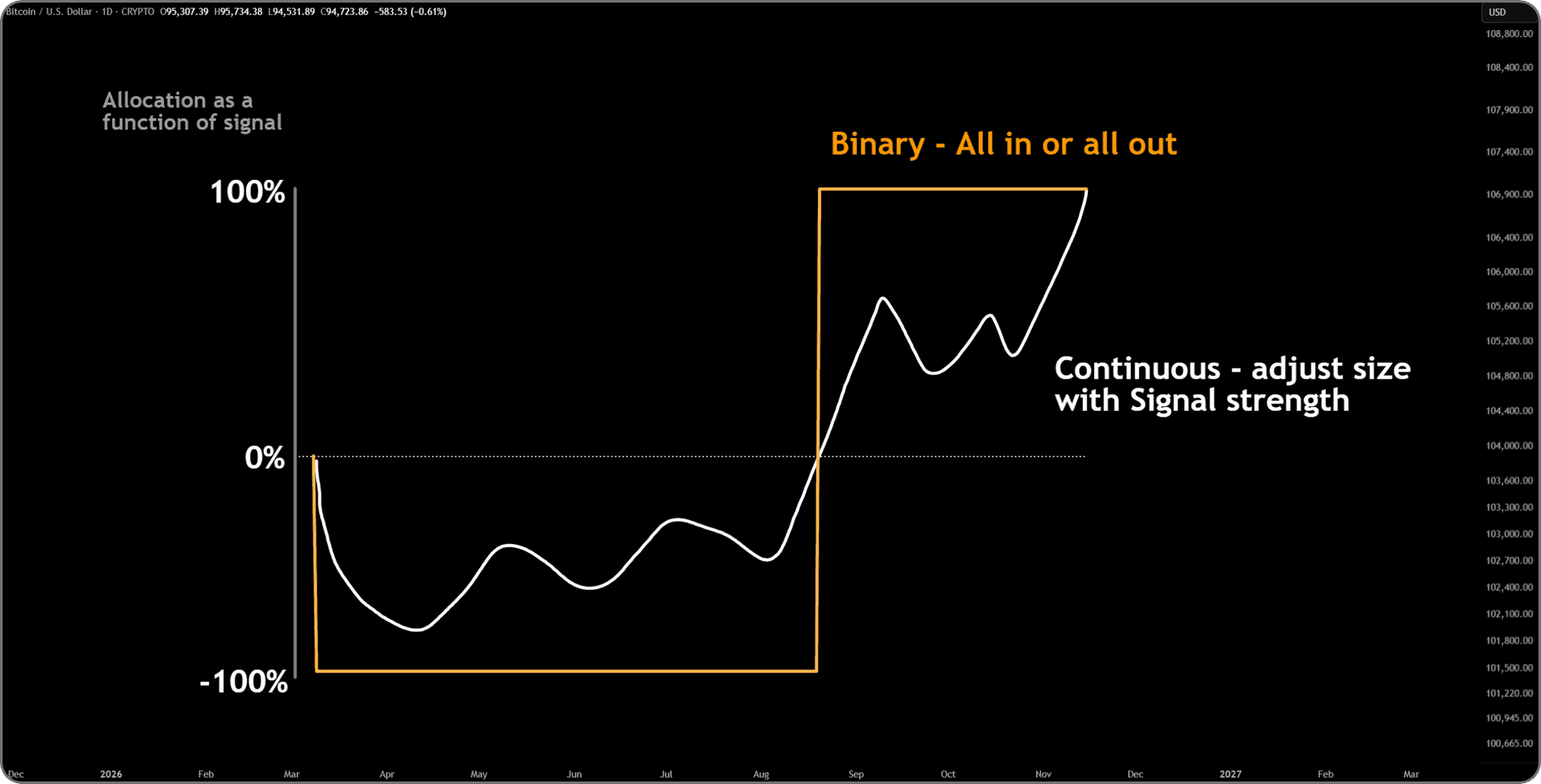
Both approaches have distinct advantages and disadvantages. Hybrid methods exist that combine elements of both, though they introduce additional complexity.
Capital Allocation Framework
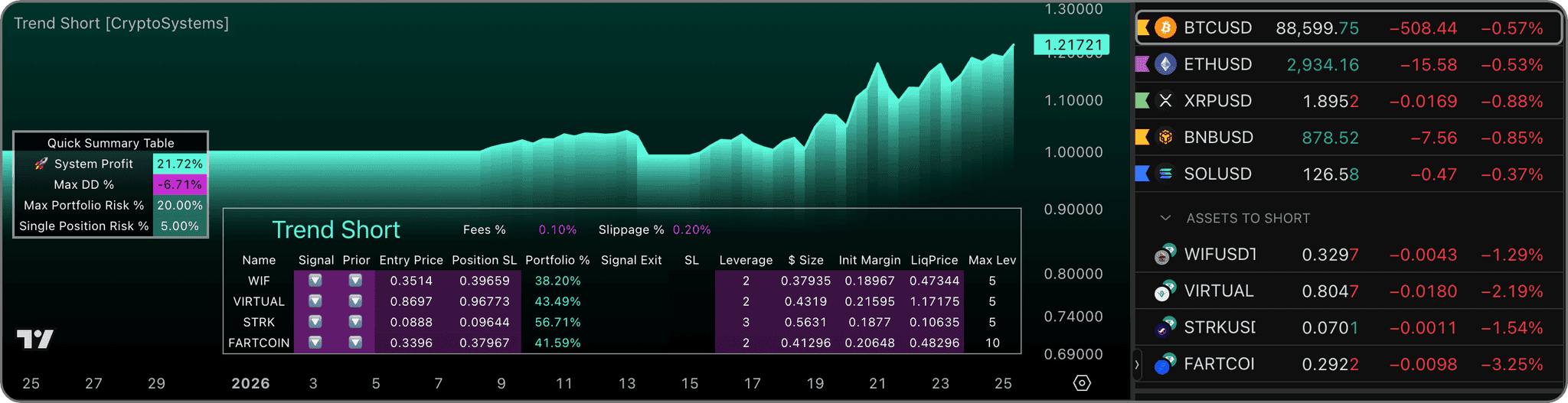
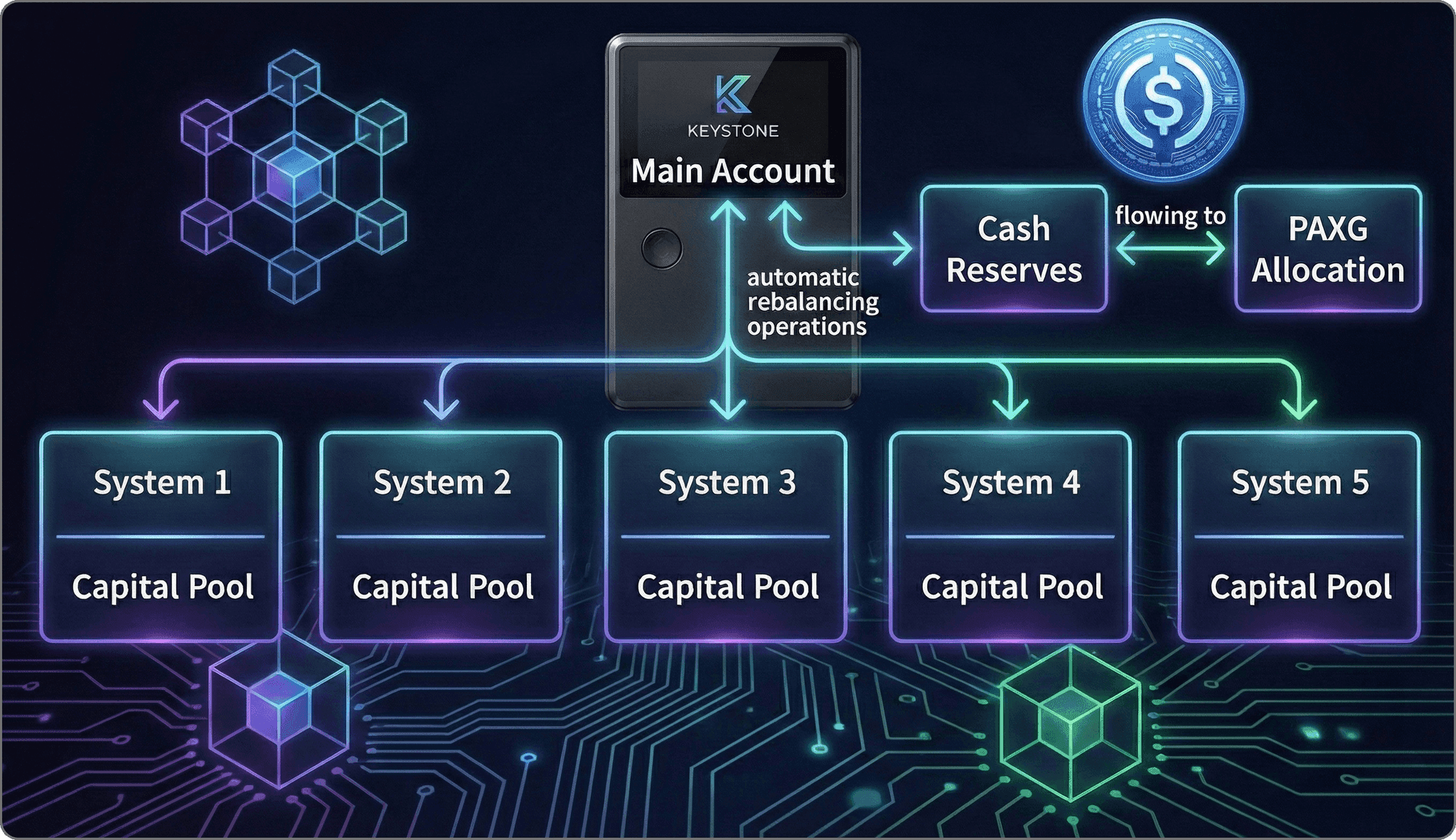
For our architecture, each system receives a fixed percentage of Strategy capital. Consider an example with five systems, each weighted at 20%. Each system has access to 20% of the Strategy's total capital.
This allocation is then subdivided across the number of assets each system trades. If one system trades four assets, the 20% capital allocation is split between them, allowing each asset a maximum 5% capital allocation.
This represents the maximum amount that any individual position will ever use as margin.
Perpetuals and Risk Normalization
We use perpetual contracts for precise risk and position management. This enables clear control over exposure and leverage.
For position sizing, we employ the concept of R (risk-to-reward) for cross-asset risk definition, where 1R always represents the same amount of risk independent of asset volatility. This can be understood as volatility normalization of positions based on individual asset volatility.
Example: When trading BTC and SOL in parallel, we want both trades to carry equivalent risk exposure. Without normalization, SOL would dominate the portfolio due to its higher volatility relative to BTC. By normalizing, risk remains consistent across all assets within each system.
This approach reduces idiosyncratic risk of any individual asset and enhances the ability to harvest each logic's strengths across multiple assets.
System Partitioning
With this architecture, we maintain clean system partitions where each system trades its own capital allocation and rebalances on position exits. This provides clear advantages at lower complexity than alternatives.
Simplified example: If all Trend Long positions are open and a Trend Short signal triggers, this setup allows them to coexist without interference.
Compare this to a fully dynamic portfolio where all open positions always comprise 100% of portfolio exposure. Such an approach defeats the purpose of multi-factor diversification—if all current positions sum to 100%, you cannot hold offsetting exposures simultaneously.
Cash Management and PAXG Hedging
With this compartmentalized setup, unallocated positions remain in cash. This available cash supports the fiat hedging PAXG allocation.
If a new position requires margin but insufficient USDC is available, PAXG holdings are reduced (with a buffer) to meet the position margin demand.
Subaccount Infrastructure
Each individual system trades on its own unique subaccount, facilitated by Hyperliquid's subaccount feature.
The main account handles capital rebalancing exclusively. Since transfers can only flow from subaccounts to the main account, all rebalancing routes through the main account before redistributing to subaccounts requiring capital.
Key operational details:
The main account remains empty (balance ≤ $10) outside of rebalancing operations
Clients can allocate additional capital to their main account at any time
On the next trade iteration, new capital is rebalanced across all subaccounts
New capital is accounted for in PAXG hedging allocation but not in currently active trades
New trades account for the updated capital; due to binary signals, existing positions remain unchanged
Capital Withdrawal
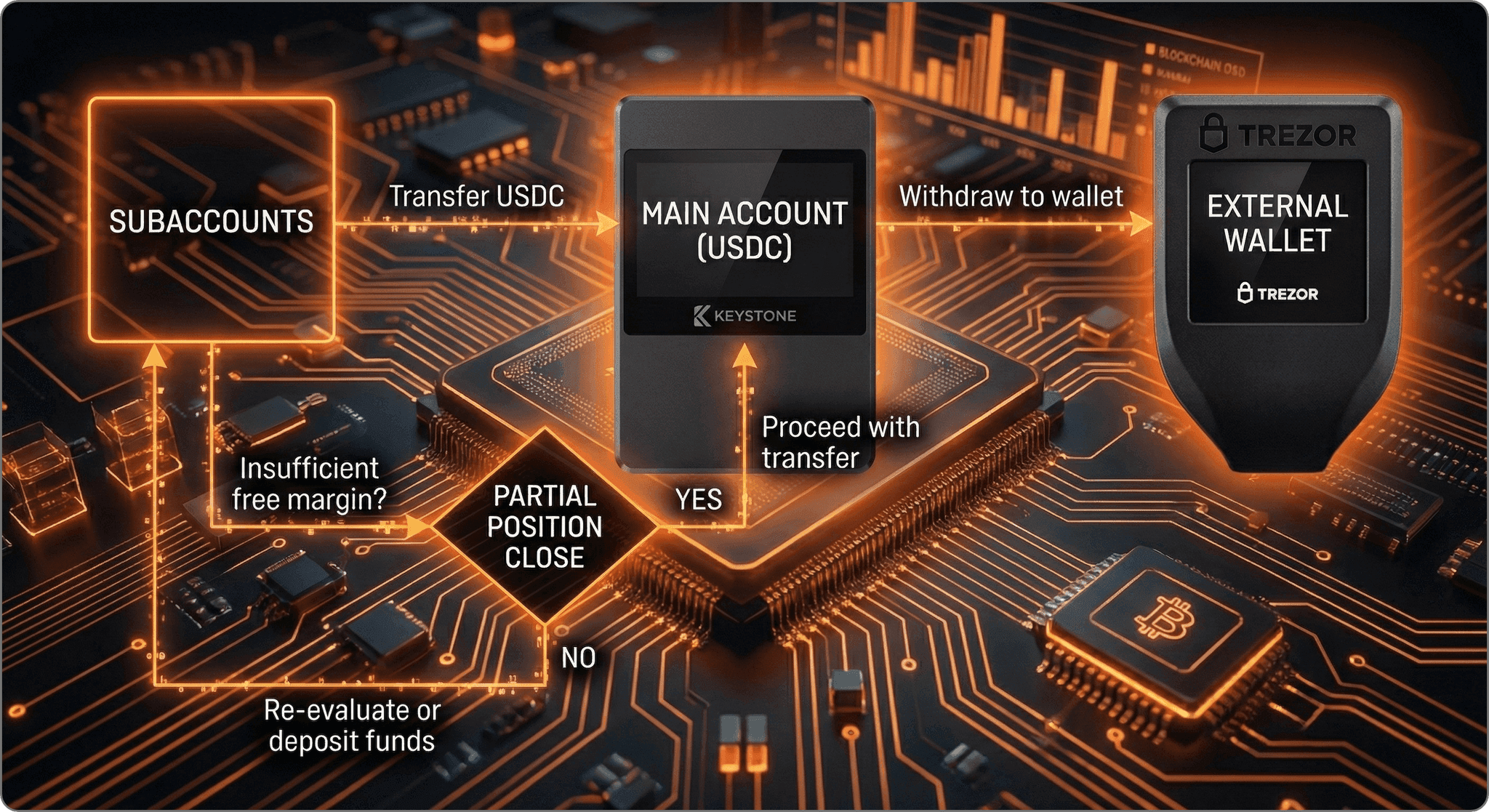
If the Operator wants to remove capital, the process is straightforward: transfer free USDC from subaccounts to the main account, then withdraw.
If more capital is required than available free margin, the infrastructure supports closing positions fully or partially. The system continues normal operations afterward—rebalancing capital and adjusting sizing for new trades after the closure of positions that were open at withdrawal time.
Important: Removing capital from a position or closing positions early will cause deviation from the expected and recorded behavior of the pure systems. As you retain full control over your own execution account at all times, this must be regarded.
Operator Onboarding
Signing up to the architecture is a simple two-step software installation process that guides the Operator through the entire setup. Everything else is handled by the automation.
Software and engineering services. Not financial, tax, or investment advice.