


System: Fiat Hedging
New subsystem for SOVEREIGN
Fiat Hedging - PAXG allocation for inflation protection
Introduction


Research demonstrates that any inflationary regime shows rather similar behavior with consistent positive expected value strategies that can be applied to hedge against currency debasement. The most relevant exposure for our strategies is commodities—specifically gold in the form of PAXG.
Reference: Harvey, C. R., et al. "The Best Strategies for Inflationary Times" (Duke University)
The Plan
The objective is to hedge cash exposure within the strategy that is not used for open positions (tied up in margin). This freely available USDC sits idle by default.
As there will always be cash exposure in the strategy (not all systems have all positions open simultaneously), it makes sense to examine how we can utilize this free cash to hedge against currency inflation.
Capital Allocation Context
As outlined in the Architecture directive, each system has its own fixed capital allocation with prolonged periods where capital remains unused by nature of not constantly having open positions.
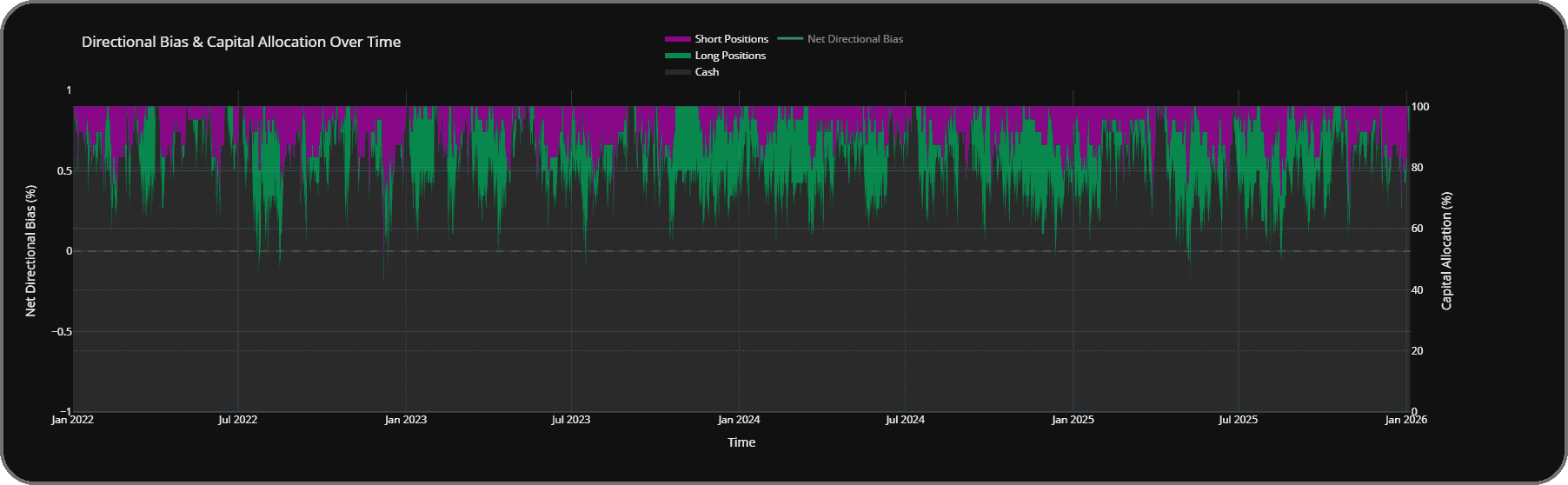
On average, approximately 70% of capital remains in cash, ready for position deployment.
This creates a rather positive effect on the portfolio via rebalancing of cash, and ensures no excessive amount of capital is put at risk simultaneously.
The PAXG Solution
We don't want this idle capital constantly exposed to fiat inflation without countermeasure. Therefore, we expose it to PAXG.
The question arises: how to implement this sensibly? Gold itself experiences ups and downs and is not as stable as we might want.
Additional considerations include available liquidity on Hyperliquid and involved transaction costs.
Addressing Misconceptions
The aim of the PAXG exposure is NOT to generate maximum returns from trading gold. Instead, it is about maintaining a CONTROLLED allocation to gold that enables effective cash hedging.
The appropriate mental model is to think of this activity as PnL-neutral—it is designed to preserve value, not to add trade risk. This also means that STABILITY is preferred over volatility and high returns.
Consequently, the gold allocation WILL underperform buy-and-hold gold. However, it will provide better stabilization to the strategy than a buy-and-hold approach, as the volatility and connected drawdowns are controlled.
For this task, and considering liquidity available on Hyperliquid, we employ a combination of an Inverse-Volatility-Weighted allocation approach and a trend-based approach. Together, these create a continuous signal that constantly adjusts the PAXG positions based on signal output and value drift of the PAXG allocation.
Inverse Volatility Weighting:
High volatility → low position size
Low volatility → high position size
Trend:
Upward trend → allocate
No upward trend → do not allocate
Both signals control 50% of the capital each. If the trend signal is allocated, it will use 50% of the dedicated capital. If inverse volatility is allocated, it will use up to 50% of the dedicated fiat hedging capital.
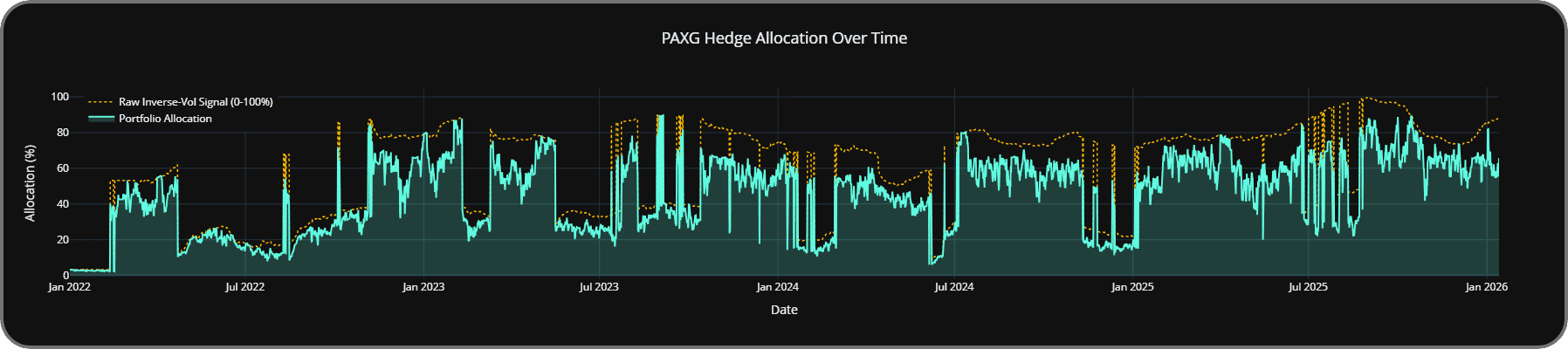
As the cash in the portfolio is not stable, the PAXG position will fluctuate. The trading positions will always be fulfilled first before any of the PAXG allocations are fulfilled. Therefore, at times the PAXG allocation will not reach the maximum capital allocation.
Example
If the portfolio has 60% in active positions and 40% free cash, and the signal is 50%, then the actual portfolio PAXG allocation = 40% × 50% = 20% of total portfolio
Implementation Notes
The fiat hedging system monitors available cash across all subaccounts and allocates a portion to PAXG based on predefined thresholds. When a new position requires margin but insufficient USDC is available, PAXG holdings are reduced (with a buffer) to meet position margin demands.
This creates a dynamic hedge that protects idle capital while maintaining full flexibility for trading operations.
Below are the standalone PAXG Hedge Equity stats:

Execution Notes
Due to the limited (but growing) liquidity available on Hyperliquid for PAXG, execution needs to adapt. For that reason, the PAXG execution considers volatility, order book spread, and depth quality to assess how active the position-taking should be.
If conditions are good with great order book depth at low spread, then the PAXG position execution will be proactively getting into positions with the intended size.
If conditions are unfavorable, then it will either only partially fill or skip this PAXG iteration entirely.
This behavior is intentional:
While the dashboards account for the execution fees of the amount of capital moved, they cannot account for account-specific execution data and changing liquidity availability. This means real performance would deviate from the backtest for PAXG.
If conditions are unfavorable, aggressive trading would only increase costs to enter these positions. Because we check the conditions and the deviation from theoretical optimal allocation on every 8-hour period, not adjusting the position during some periods is not a concern.
Software and engineering services. Not financial, tax, or investment advice.