

Directives
Dec 1, 2025
Why Multi-Factor Matters
And why single system strategies fail…
by CelestialEye | Quantitative Systems Engineer
Introduction
GM!
Let’s start with what most people tend to start out with when starting to trade:
Finding some sort of strategy and running it live.
Whether that is in the form of copy-trading someone, “adopting” someone else’s strategy or just simply selecting one of the many indicators that exist and following its signals.
Acknowleged:
Most of the time, the typical retail approach is to take two or three indicators and interpret a signal over the last couple bars that would have worked, then observe and attempt to trade this over the next couple bars…
To find that this is not working well, so they continue finding more layered indicator signals over different timeframes that - over the last historical trades - seem to have filtered out bad trades and left good trades…
To then either go into a process of infinite complexity with a 10-20 step process…, or getting frustrated and scrapping this whole process to go through that cycle once again with different indicators or “interpreted” signals. “If this tool does not work, I use that tool, and start over.“
To the slightly more educated the above sounds insane. Yet it may also sound familiar because we as humans have the tendency to fall prey to this process.
Single indicators are a great starting point, assuming that a single system is found to execute on. As I mentioned above, the reality is that most already struggle with this, because they are overwhelmed by all the technical indicators that exist, as well as their combinations that chase “perfection”.
Overwhelmed by all the possible finger drawings on the chart that they will find when researching something, all the many other traps that easily and quickly overwhelm whoever wants to start trading.
Another very common problematic element in someone's trading journey is that any single system is regime dependent. Meaning there will always be periods where it works and periods where it doesn’t work.
The Treadmill Of Single Systems
Generally a system tends to be deployed after a period of time where it did well, which leads to a rather predictable behavioral trait: Namely “running” away from a system after experiencing its first drawdown (DD). What happens then is a natural process of loss aversion which usually goes as follows:
Horrified of losses (entering DD)
Hold tight until losses get too extreme
Jump out of system
Find a new shiny system that did well during the recent period where the prior one lost
Trade it for a while until a new DD emerges
Go back to step 1 and repeat
The loss aversion element makes this cycle become a drawdown chasing strategy. And this tends to be a vicious cycle that becomes difficult to exit.
But even if you don’t fall prey to this and instead just continue executing a single system through all the highs and lows, this too will always be a rollercoaster and can be mentally difficult.
A big part is also that the regime dependency of individual systems means that deep and prolonged DD’s will happen throughout the journey - these tend to heavily impact the ability of the portfolio to properly compound, and instead “reset” the progress back to a stage months ago.
Somewhere throughout this process anyone trading will painfully figure out that there is no single system that will work in all conditions and be consistently profitable. Yet most people are searching for this kind of “holy grail”, because accepting that they have to lose temporarily in the markets is more painful.
This is why all the ads and scams work that promise a 95%-100% win rate system, or a system that turns $500 into $100k over 1 month, or anything similar like that.
The reality is of course that you can very easily and quickly go from $100k to $500 within a week by following any of these.
The Holy Grail
Let’s talk about the real Holy Grail.
The real Holy Grail looks a lot less amazing and is much harder than what most imagine.
And this “Holy Grail” is diversification.
But not diversification of assets - doesn’t get you far in Crypto, where most tokens are highly correlated.
And not the diversification between different technical indicators to derive the same signal type, as seen in this image showcasing a negative example:

Even if we use different types of technical signal deriving indicators, we still see that trend signals will be very similar. In this case here, we can see that the DD’s happen at essentially the same time - and the periods where the systems are profitable are also the same. The difference between the individual equity curves is mostly noise - as in one signal triggering a bar earlier, or a bar later.
Therefore the actual required diversification is a completely different one.
Factors And Correlation
And this is what factors are for. In our case we’ll use this as a simple classification of general behaviors and characteristics of different types of market exposures.
Because what we'll want is a diversification of factors in the portfolio. The ideal portfolio contains multiple different systems that behave differently and provide returns to the portfolio at different points in time.
This is not something that works with 9 variations of a trend-following long-only system.
Instead it requires a diverse set of systems that are exposing themselves to different market regimes/behaviors and harvest different moves/risk premia.
Our goal is to run as many sufficiently uncorrelated systems as possible, thereby reducing reliance on the performance of any single system:
to provide returns
to remain robust over time
to perform across market regimes
We can essentially focus only on having systems that harvest certain market moves and then put them together in a portfolio. This mitigates individual downsides, while enhancing the strengths of any individual system.
The reality of this is that no individual system matters much on its own. Only what they add to the portfolio is relevant - as only on the portfolio level we see the magic happen, not on the level of individual systems.
A simple introduction for how to think about this is well described in this linked thread by Ross Hendricks quoting Ray Dalio.
A Practical Perspective
We have two systems that are harvesting different directional asset behavior.
Both on their own do not just have high DDs but also rather long DDs:
367 and 289 days respectively with an average DD duration of ~15 days and an average DD of 11.5% and 10%.
Both are interesting but also extremely risky on their own (70% and 55% max DD)!
System A:


System B:


Instead of tinkering on the individual systems, the biggest advantage we can get is actually just combining both of these into a portfolio and then rebalancing either based on fixed periods or on a trade-by-trade basis between them. As we can see now, they perform well during different periods.
Comparison Systems A and B:

Most importantly the DDs:
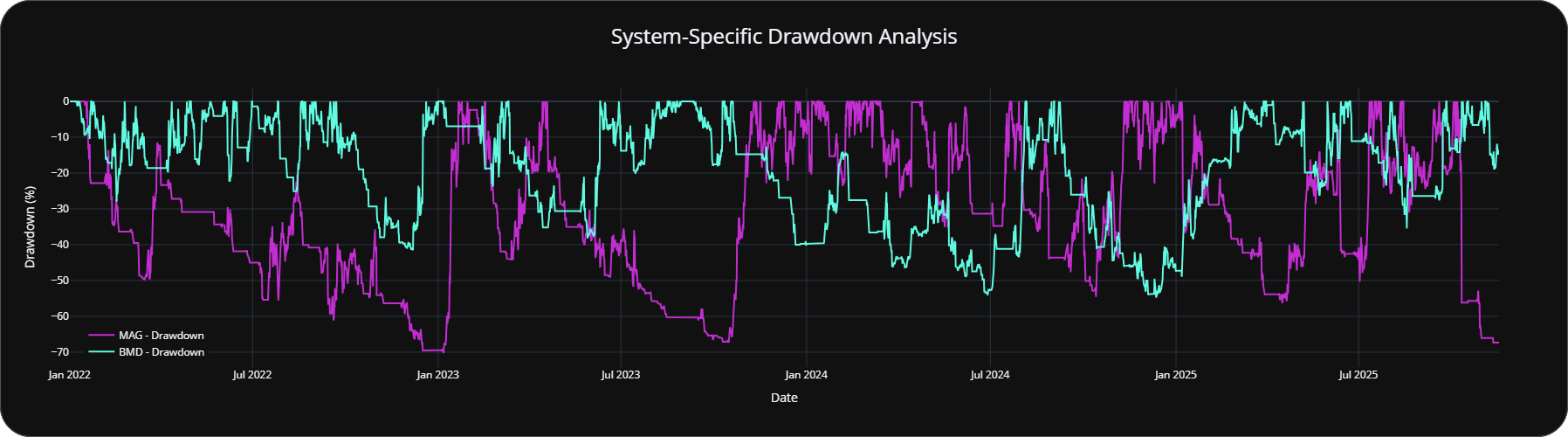
This is also wonderfully showcased by looking at the long run sharpe ratio of both:
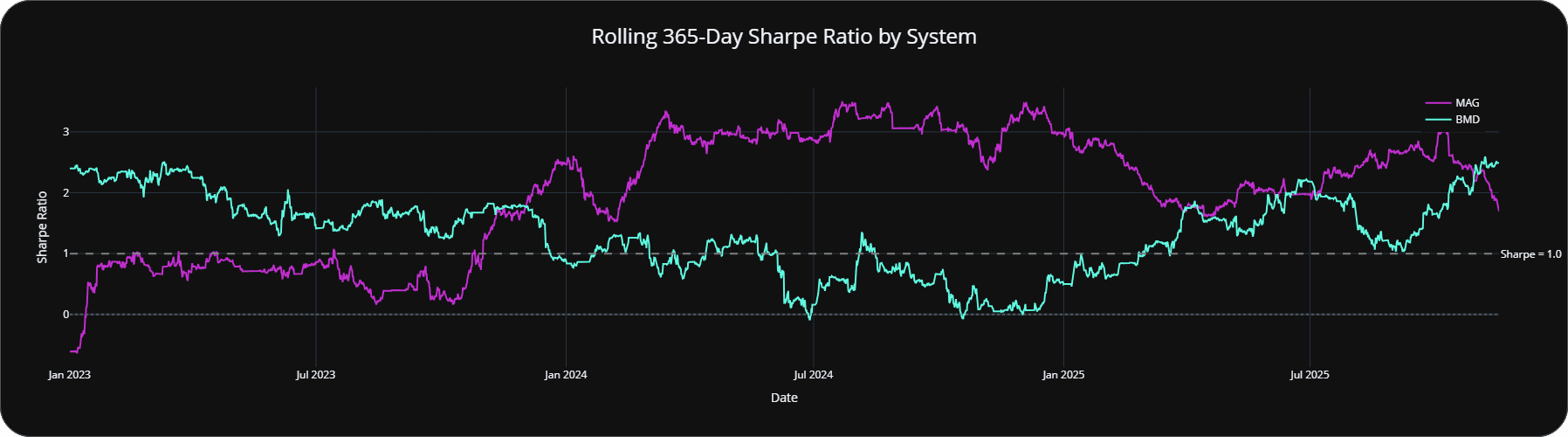
For this case, bringing these two different systems together at an equal split, we want to rebalance after each closed trade for simplicity.
And below we can see the results:
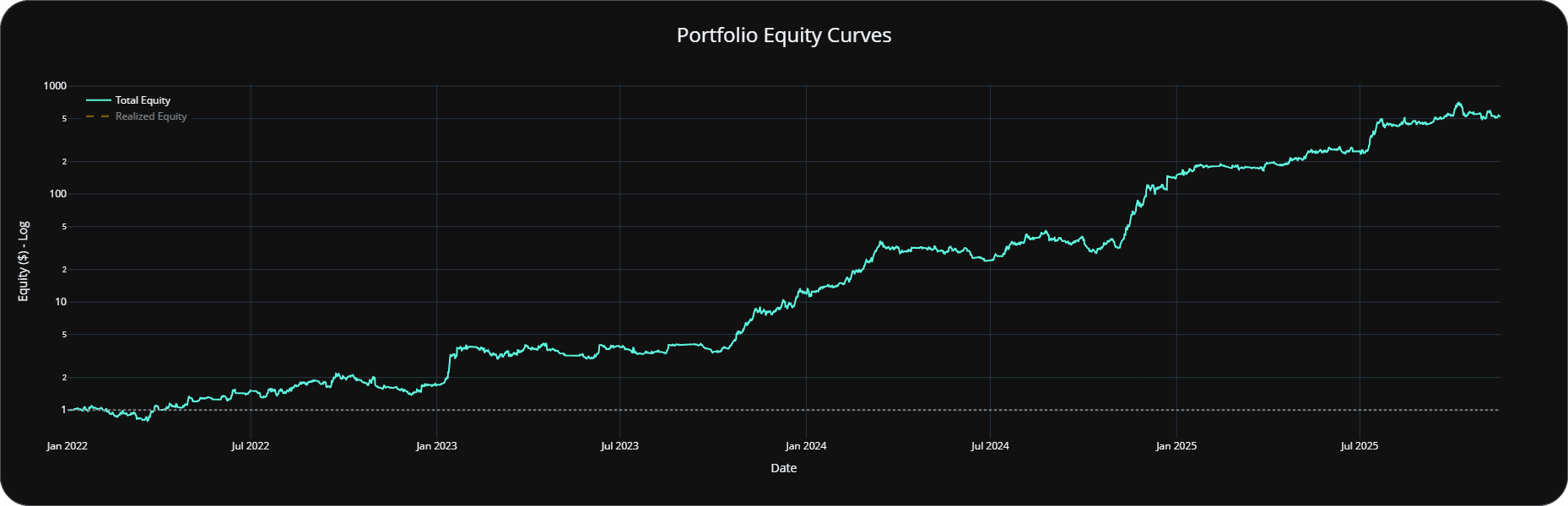


This is still a risky strategy, but because we have added diversified systems, all metrics improved drastically and we reduced the risk of any individual exposure while making the return profile more interesting, with more frequent positive returns, and lowering the strength and frequency of negative returns.
For this reason sensible diversification is the holy grail and that is why multi-factor matters.
Overview